
Every time I have heard the response to what someone would do given a billion dollars, the answer always includes doing something that would change the world.
People are genuinely good at heart. Everybody wants to make the world a better place; everybody wants to help. Why then is there so much poverty and suffering in the world?
The answer, I believe, lies in our mindset towards life -- the established set of attitudes that we hold towards living, working, and existing. Such a mindset is not easy to change on a large scale, especially given that living standards generally remain the same, or improve, from one generation the next.
Most of us live in a bubble. We don't see the full picture of what's going on in the world. OK, we at least have an idea. We read news stories and blog posts, see pictures, and even watch videos. We have a general idea of what it's like out there. We know the world isn't all smiles and love.
Why do you exercise? Why do you eat desserts? Why do you go on vacation? Why do you laugh? Why do you dance? Have you not see news stories, pictures, blog posts, and even videos of all those things?
You do them because experiencing them firsthand is the only way to really experience them and bring about change. When someone asks you what the dessert tasted like, you can explain it. When you exercise, your body responses by becoming healthier. If you only watched a video, would you be able to gain the same experience or induce the same change?
By living in a bubble, physically isolated from the parts of the world that need change, your mindset is not going to change no matter how many videos you watch. Your daily actions, the choices you make, and your attitudes towards life will not be affected the same way as they would if you witnessed the poverty firsthand.
Many people living in third world countries also exist in a bubble. They have high living standards, clean water, abundant food, and easy transportation. They lock their doors, roll up their windows, live in gated communities, and isolate themselves from the outside world, from the part of the world that needs to be recognized the most.
As long as those with ability to change the world isolate themselves from the part of the world that needs change, those people are not going to be fully equipped to change the world.
World peace requires people with a mindset for change; people who have experienced and witnessed firsthand the things that need changing and who unconsciously make choices that are conducive to positive change.
That doesn't mean you should give up your position in the developed world and become a beggar on the streets of Old Delhi -- that would be selfish! You're in a position to change the world. The world needs you to maintain that position and use your power to become a pioneer of sustainable abundance.
Even a short exposure to the third world -- several weeks or months is best, but even a few days of travel through poverty-stricken areas is enough -- will change your mindset in a way that promotes world change.
The other day while browsing the web, I read a blog post that had a picture of a fancy house. It looked similar to the house I grew up in; a brick house with green bushes surrounding a big white front door.
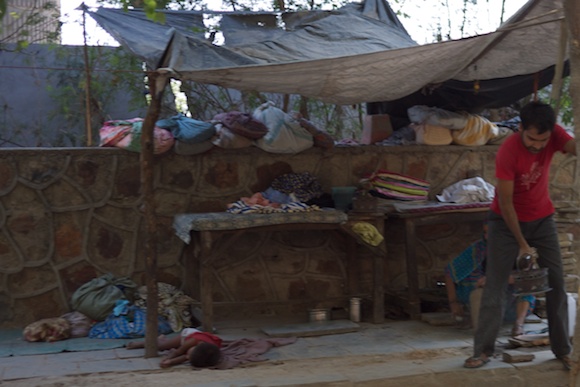
Instantly, the very first thing that came to my mind wasn't home, but an image of the family of four living on the sidewalk outside of the place I'm currently staying. The children sleep on a piece of cloth on the ground; the roof of their home is made up of plastic strung between two trees. The parents run a laundry ironing business from a wooden table propped up against a stone wall.
This family is lucky to have a clean, safe place to live and a job to feed themselves.
Suddenly I realized why seeing things firsthand is so important. If everybody thought of that family of four when they looked for a house to buy, how many people would be buying six-bedroom, four-bath houses for their family of four?
75% of the world's population lives on less money than a kid working minimum-wage at a fast-food restaurant in the United States or Europe. If you're reading this blog post, changes are you're rich compared to most of the world's population. Think about that the next time you're buying something.
Everybody who can afford to travel on an airplane can travel to a third world country. Many people dismiss the thought of traveling to third world countries out of fear or concerns for their safety. But those fears are misplaced.
The greatest benefit of traveling to third world countries is its potential to change your mindset, thereby increasing the chances you will affect the world in a positive way.
One of the best ways to ensure this change of mindset occurs when you visit a third world country is to really pay attention to the way poverty-stricken people are living. Soak it in. Look at the map and take a rickshaw or taxi through a poor area (you don't even need to leave the taxi if you don't want to).
I'm traveling through two third world countries (India and Nepal) and one second world country (Vietnam) over the course of six months on a budget of $3,000 USD. I'm not living on the street. I didn't take a boat to get here. I'm not dying of sickness. I'm not being shot at or mugged. The only thing that's changing is my mindset, and subsequently the likelihood that I will do things in my life that will change the world.
If you really would take that extra billion dollars and do something to improve the world, then why not take the money you save for your next vacation and do something that will make you a more capable pioneer of change?
It’s the middle of the night here in Vancouver as I write this. Reading your post, I now feel grateful for all that I have vs. the irritability I was feeling at being awake, unable to sleep. I have a warm, clean bed waiting for me when so many children around the world do not.
I sometimes forget how truly blessed I am. Thanks for reminding me.
Sandi
You’re welcome, Sandi! I don’t think we can ever be too grateful for what we have. It’s so easy to get caught up in our own problems and forget that there are bigger, more important problems in the world.
Raam, I must say that the way you wrote this makes all the difference. Most people write angry posts and blame the “rich” for the world’s problems – I can hardly disagree more – but you write about how everyone can make a difference, and how we just need to know and be aware of what poverty exists. I have lived in Iran and Turkey as you know and I was lucky to have a very comfortable lifestyle in both (the politics and outside situation nothwithstanding) but I was able to see a lot of poverty. I am not of the mindset to help the beggars by giving them money but by giving them opportunities so they can help themselves. Enabling them to help themselves is my theory. I wonder if you agree. Anyway, your writing voice is a big asset so continue to use it well as you are here….
Thank you for the feedback and the support, Farnoosh! You’re always incredibly insightful!
I absolutely agree with and support the idea of giving beggars opportunities! I think that’s the best way to see how genuine they are — if they’re willing to do anything to work, then they are honest and deserve money!
I haven’t done much research on the subject, but I’ve always wondered if the beggars I saw back in the States (in Boston to be specific) really couldn’t find any work. Or if they were just being lazy and/or begging because it paid more for less effort.
I could bet you anything it is the latter. There is no way on earth they go hungry – they can get foodstamps. And it’s just easier for them to go beg. I am devoutly of the latter opinion. This country is full of opportunities AND takes care of those who are less fortunate. That is why I never ever give them money. If they are selling a newspaper, yes I’d buy. If they are playing an instrument, yes I’d donate. If they are contributing to society in any way shape or form and I feel sincerity, I back them up but an empty hand outstretched in my direction, when I worked harder than anything in this world for every penny, no thank you – I do not encourage that…..Ok I got carried away but I am so happy we agree. You be safe and healthy please, Raam!
Raam, you are dead on here, man. My personal experience of the thrid wold is pretty limited, but over the next few years I am going to be right in the middle of it, and I think it’s something everybody should do. When I moved from Alaska to New York with almost no money, I found myself a month later with two decent paying jobs and an apartment, a cell phone, a guitar, etc. I realized that the United States is an extremely easy and wealthy nation.
I can’t wait to get out to Asia and see how the rest of the world lives. And I can’t wait to share all my experiences with the rest of the world.
Thanks, Eli
Thanks Eli! I spent the first 28 years of my life in the United States and now, after having lived in a third world country for over three months, just the thought of how easy and abundant things are there is enough to make me cringe. I can’t even imagine how I will feel (and the insights I will have and write about) when I return to visit the States in September.
I’m looking forward to reading about your experiences in Asia! Hopefully one day our paths will cross and we’ll get to meet in person! 🙂
Hi Raam,
I’ve read your blog for awhile but this is my first time commenting. I have spent sometime in third world countries for work purposes in the past. You are right, there are wealthy people that live in these countries as well. I am a huge believer that we are all citizens of the world, not just our home countries. And there is no better way to understand our own problems at home then to go out and see what others are thinking or experiencing in different cultures and settings. I will disagree slightly in that I don’t believe you have to specifically go to a poverty stricken area to get the benefit, but I see your point. Merely putting yourself in another setting to see how others live and what is important is as important IMO.
Hi Marc, thank you for the comment and for reading!
I agree that simply putting yourself in another environment to see how people live is important, but when I was writing this post I was thinking about the many people who already live in third world countries and who frequently visit the developed world. There are lots of people who frequently travel (on business for example), but they don’t see (or at least they’re not trying to see) the poverty and imbalance that exists.
If think if we really take a moment to see the poverty and really soak in the experience, it will force out the humane and caring side of us that wants to help fix the imbalance. This would result in us taking more actions that are beneficial to the whole world.
I agree fully that first-hand experience is the only way to obtain that invaluable and mindset-changing education that third-world travel provides. Seeing a group of street kids sleeping on the street for the first time forces a person to immediately re-evaluate their views on life. You have no other choice. And as you said, the result is positive change, even if it’s only in the form of a small increase in compassion.
I think we should also focus on the positive aspects of third-world countries. While the poverty is clearly unfair, there are also endless amounts of poverty-stricken people who have seemed to discover an inner peace, a calmness, even a level of happiness that all of the possessions we amass in the west simply doesn’t provide. And there’s a great deal to be learned from that as well.
Hey Earl,
You’re dead on with that part about possessions not providing happiness. I think that’s one of the benefits of minimalism and one of the driving forces behind its growing popularity. If we realize that stuff doesn’t equal happiness, we can redistribute our abundance to places where it matters… even if that means using it to travel the world and get a better perspective for what needs changing!
I completely agree that seeing and experiencing things for yourself is key for true understanding about what is going on in our world. This goes for seeing both the challenges, as well as the joys, of life in third world countries. When we’ve spoken to students in the United States and Estonia, we’ve shown a video we took on the back of a motorbike in rural Cambodia. In the video, there are lots of kids laughing and waving. Many times, the kids will respond with, “They are poor, but they look happy. I guess you don’t need to be rich to be happy.”
I also believe that it’s necessary to see the development and environmental changes happening around the world. After visiting China for three months, I have a whole different appreciation for the change and development happening there. It’s impossible to really fathom by reading articles.
Great post.
Hi Audrey, thank you for the comment!
Kids are incredibly insightful. Sometimes we need them to point out the obvious because we’re too caught up in the complicated!
I think education is the only way we can ensure long-term positive changes in the world, especially education of our younger generations. Children that learn from an early age that stuff doesn’t equal happiness will grow up with more appreciation for things and be more willing to give excess to those who need it.
Unfortunately, that type of education on a large-scale is a huge wall to climb. Those in the advertising industry (and those with the money funding the advertising industry) will stop at nothing to insure a future of money-spenders!
I think that will be very difficult indeed. The problem is also that all change must come from within. Would young children and teenagers buy into the idea of their parents that buying things isn’t going to make them happy? After all, it’s natural for us to want things (like food, shelter, etc) so why not a new toy to play with? You learn the most from your failures so you must realize yourself one day that you’ve spent money on things that only brought temporary happiness…
I agree that it’s natural for us to want things, but what’s not natural (or at least not conducive to sustainable abundance) is children having no concept of “unnecessary stuff”. If children were educated about how buying expensive high tech toys meant that so many other children go hungry, they will be less likely to contribute to such imbalance as they get older.
The long-term solution isn’t going to be applied overnight by teaching a new class to kids, but this is something we need to be thinking about for the long-term. I honestly feel the education should happen at home, with the parents, but I see the inertia going in the other direction — parents are becoming less and less apart of their children’s lives, so the education needs to come from somewhere else.
Wow, Raam! That’s a big challenge you are throwing at us, and definitely one that would make all the difference. It’s sad how we (or at least I) so rarely even think of third world countries when planning my vacations but automatically think of just the “safe” options.
That’s why, I’m glad there are people like you who have taken the challenge and gone to see firsthand — and don’t keep the insight to just themselves. Through your words, we can share some of the life-changing effect as well. You’re probably right that it’s not nearly enough, but still, it’s a start.
Thanks Jarkko!
You’re right that not everyone is able to travel the world. That’s why I think it’s more important than ever for bloggers like us to make an effort to shed light on the changes that are necessary in the world!
I always wanted to travel, especially to Cambodia. I want to get out there and explore, theres so much out there.
It’s never too late! 🙂 Making that dream come true is easier than you think. You just need to determine what things you can sacrifice in the short-term to make the dream a reality.
I think it is worth noting one thing, the people in poverty in most part are more happy than those in the third world. The level of misery in the third world is reaching astonishing levels, as well as suicide rates far beyond that of the third world.
So although removing poverty is certainly worthy, and I am not saying poverty is a good thing by no means, we should focus on what makes people happy, because once the third world has money it wont be happy.
Living in the UK many Indians migrate here and they are miserable as sin once they get their 8-5 minimum wage job and yet they would be considered wealthy to their native land.
Zen knows that simplicity equals happiness and poverty demands simplicity. Therefore the balance is to have total abundance and I mean total and once anyone in the world can have a ferrari, no one will want one.
So we need to achieve an abundance where aquiring things and wealth does not elevate you above others because everyone has all the abundance they need.
This is only possible by changing the debt based money system. Any additional wealth ever produced will always be consumed for as long as people contiune to use the rupee, dollar, pound etc as payment.
Love your train of thought here, Dan. I think you’ve really hit on a key point with achieving a level of abundance where acquiring more doesn’t change anything.
I think that the Internet has started doing that: When everyone has access to the same massive volume of information, we automatically look for better things to do that simply ingest endless amounts of information. As a result, people start communicating more (the rise of things like Instant Messaging, Twitter, Facebook, etc., are evidence of this) and looking for ways to collaborate and share ideas and stories (blogging) instead of just sharing articles of information.
We’re a long way away from a similar affect in the real world, but I think it’s an excellent example and a great catalyst for bridging the gap.
I’ve been to India and Nepal as well. I would put it a different way – you don’t need to go to these countries to see poverty. You have it in your own place. I live in Eastern Europe country and surely I can say that here is a lot of poverty here as well. The question is, what you call poverty?
I would even say that in some point that India family can be happy – they live on their own having their own business – it means = security. They will not die because of winter. They have food. Comparing to that, seeing with my own eyes lives of people in my own country, I can say it’s more difficult here. To survive, people need shelter here. If you are not lucky with your intelligence, you are stuck with a very hard work for a very minimum wage, with boss that is hateful and so on. Some people work 1,5 of full time just to pay their bills and have something to eat – and they are very stressed out! Older people cannot afford medicine. They have to choose – whether to pay the electricity or buy the pills. THAT is poverty too. And I can say that those people in India have more sun in their lives and surely are not so stressed as people here.
How to change it so that there would no be poverty? You say, “do not buy such expensive things”, give some money to those poor or make something that they would have a chance to choose at least. OK, that is noble. But we cannot forget what is the real reason of poverty. These are the huge corporations together with banks, that are now deciding what to do with the world – take more money from the people via tax, VAT, obligatory pensions, expensive oil, expensive food, dreadful agriculture and so on. Read about Monsanto. Read about who took all the money in Egypt. Read about banks making false money and debt that kills the nations. Read about “just” wars that are about oil. This is the real cause of the poverty. Soon we will see it worldwide, if people will not wake up to see this real cause.
For a short time in Germany between WWI and WWII people experienced real industrial boom, they built loads of highways, everything was flourishing just within couple of years! And that happened at the same time when other European countries where in depression. And why? Because the government introduced a debt-free money and kicked all the banks away. There is enough for every human being in this world – what is causing the poverty is debt and vampire banks/corporations which bring laws that take everything from the people.
WhiteLilly, thank you so much for adding your thoughts here. These are exactly the kind of conversations we need to be having!
I’m weary of blaming the banks/corporations/governments because it’s the people who make up all of those and keep them running. By changing how we live, we change how the world works. If we set an example for others to follow and voice our opinions about why the way we’re living is so important, others will hear us.
Imagine for a moment that everybody in the developed world who lived within walking distance to their workplace, decided today that they were going to walk instead of drive. Suddenly there would be less demand for oil.
The disparity, I believe, comes from a lack of global consciousness. We are not individually aware of how our actions affect the entire planet and all its residents. Forget the governments, corporations, and banks for a moment and just think about the power of the people. Not the people in one country, but the people of the planet. From that perspective, governments and corporations can do nothing. Without our cooperation, they’re meaningless.
If we live our life and make choices with the welfare of all humanity in mind — from the poor homeless people in India to the stressed and struggling people in Eastern Europe — we can have a positive effect on the lives of everyone.
I have been to Haiti after the earthquake a few times to volunteer at an elementary school, my experiences there were truly life changing. You are absolutely right, we hear and read about third world countries, and what people go through, but seeing and experiencing it first hand is completley different. People tell me im crazy and don’t understand why i would want to go, but i wouldn’t change my experiences there for the world. I love the people with all my heart. They have touched my life and helped me view the world in a different way. I will never again complain about anything, because i know whatever it is, it can always be worse. i definitely agree with Dan when he said that people in poverty are in general very happy. Every time i go to Haiti, i am greeted with smiles and hugs. The children that attend the school i volunteer at have become my family. Everyone there are the most incredible people i have ever met. I am so lucky to have met them, and to have them in my life. If more people decide to go and see how people in third world countries live, there would be a greater chance of making a change. Instead of just hearing about something and feeling bad for ten minutes then going about your normal life, get out there and make a change!
thanks~ Annibelys
Annibelys, thank you for sharing your story and reminding us to be grateful.
Nobody wants to be unhappy, even those who are poor and having nothing. No matter our circumstances, the majority of humans will look for the positive side and make the most with what they have.
But that doesn’t mean they deserve to suffer or that they should live a subpar quality of life. Just as we wouldn’t want a family member to suffer or experience a quality of life that we consider inhumane, we shouldn’t allow our human family to experience the same either.
That’s why I believe that all of us (but especially those of us in privileged societies) have a planetary social responsibility to uphold.
We should be asking ourselves “what’s enough?” and then striving to create lifestyles that minimize waste and live within that enough. We should be using our excess to give back in whatever way possible (as you’ve been doing with volunteering your ‘excess’ of time and experience).
Thank you for being you and sharing as you do.
Thank you so much for writing this. I truly agree with you. I was born here in the U.S. but when I was 10 my family and I moved to Paraguay. It is a Third World Country. I was shocked at the things I saw and learned. I am an American, but after living there for 8 years I relate to them. It is a part of me. I learned to be like them. Live the same way and see life with different eyes. I am back in the U.S. now and appreciate everything around me. A simple warm bed and bath seem like the greatest blessing to me. And it is all thanks to that life changing experience i was able to obtain. It hurts to see it, it hurts more however to actually experience it. It is a brutal eyeopener people need to have to be able to do something about this World we live in and improve it.
You’re most welcome, Ashley — thank you for sharing your story here!
The simplest things in life are the ones we should be most grateful for and if we don’t feel grateful for anything, that should be taken as an indication that we’re taking things for granted.
I’ve been back in the United States for a little over a year now and it’s amazing how easily we can forget how fortunate we are. But, simply rereading some of the posts I wrote (like this one), I’m very quickly reminded just how fortunate I am and how necessary it is for me to use my time on earth wisely.
I really enjoyed stumbling upon your article. It was well written and in line with my thoughts. I am living in Guyana, S.A where our poverty level is just above Haiti. I moved back here from the States and people thought that I was crazy for leaving. After living here for a year, I have truly changed my mindset, spending habits and way of life. I have become simple and more grateful for all that I have. Hot water, AC, internet, running water are all luxuries for many of our people. I thank you for your well written article that makes me more convinced than ever that this is where I belong.
Tasha, thank you for sharing a bit of your story here. It’s really amazing how a shift in our perspective can change our entire atitude towards things that others take for granted.
Coincidentally (or was it?), I happend to look up this post today so that I could link to it in another post that I’m writing. Despite having written it two years ago, I read it again today just before you commented. 🙂
I really enjoyed this. I would like to be able to visit a third world country, unfortunately, first- world or not, I can not afford the plane ticket. I am hoping to be able to go soon. Thank you for your insight!
Hi Kim,
I’m glad you enjoyed this–thank you. Save a little every week and before you know it you’ll have enough! I went to India for 6 months on just over $3,000 total. You can see all of my expenses, as I tracked them meticulously in my Frugal Travel Reports. 🙂
Im 14 And I Am Reading This For A Project I Really Dont Understand This But It Helped Me Out On My Project So Thankss !!!
Hi Treveon,
What would you like to know?
I just moved to a small village in Guatemala and I could not agree more with this article. Well written, well expressed, well done!
I hyperlinked to it from my recent blog post about ‘experiential awareness” or rather, first world travelers who go to third world countries and simply…don’t get it.
The greatest cultural difference I notice here is that despite the shocking poverty levels and unfortunate circumstances, people are kind, generous, and positive! All the time! What a lot we have to learn.
https://jessicabeder.wordpress.com/2014/07/13/experiential-awareness-traveling-true-in-the-third-world/
Thank you, Jessica. Positivity is so underrated! If only everyone would just be more positive, to think about the positive side of things even when there’s an obvious negative, the world would be a better place. That’s not to say that we should ignore problems and live in a dreamy utopian self-delusion, but acknowledging problems and responding with positivity and positive action is certainly more effective than responding with yet more negativity.
I like to remind myself often that life is short and we have two modes we can choose to spend our time here: happy or unhappy, positive or negative. It’s really up to us, and that’s what makes life so great: it’s up to us, it’s positive. 🙂
You want to know how to make world peace a reality, well, here you go folks 🙂
Along with food forests, wire/tunnel like structures over sidewalks made of material that will not rust and stuff that have food and other plants growing/wrapping around them making for a beautiful walk and plenty of free food that you can grab along the way, countless things can be done to cities/buildings/etc to green things up, multi storied/layered plant troths/trays/pots, gardens, etc many people around the world can grow enough food in there backyards and cities to more then feed the entire populous, you can have multi layered gardening/growing/food trays, trays placed on walls, growing ops in houses/buildings, on walls and so on with the proper lightings (And yes we can build underground and in other cool areas too for those who wish to do so).
There is more then enough room for greenery and the lot and we will have several times more then enough green energies/power/etc, as well as water/liquid/food for everyone/thing (With no money there is no worries about processing the salt water and converting it to fresh water through desalination plants and other methods like reusing/recycling your own water, complex/flexible/highly effective and pyramid +Self moving automated solar panels and magnifying glass like effects and complex wind turbines and countless other things with systems/methods and so on that would cost an absolute fortune back in the days of money that people can now actually use and have many do at home methods and there will be more then enough changes made to allow for people to figure out how to make sure that we no longer require pesticides and other harmful things and that rabbits and other creatures do not eat/ruin/destroy everything and get out of control with population, diseases/etc, so that we can all, humans and non humans alike properly benefit and have full lives, not to mention all of the water recycling/reusing methods and all the rest of it that will be put into place for everyone – No more money folks, no more money)
Plus many more non polluting energy sources/etc to support everyone with a comfortable lifestyle, including the once homeless/etc who will be living in what were once banking/corporate buildings/etc/etc, these buildings and other structures/etc being converted into living spaces and other useful outlets for true/guaranteed sustainable living for all (there will be no more insane waste of space/resources and all the rest of it and just here on Earth alone there is far more then enough materials/etc for everyone and we can clean up our mess and make this planet better then it has ever been) and speaking of space, yes we should pay attention and learn from it, as in having enough professionals/equipment to monitor 100% of the skies for killer rocks and other dangerous cosmic activities and have more at tenting on plans to take care of an otherwise lethal situation, to be healing/monitoring the earth/ourselves/life, we can explore Mars and the rest of it later once we have solved enough of our own troubles.
You’ve got all kinds of web services that allow you to design your own home, gardens and countless other things, including ideas/inventions and the likes, those along with schooling/teaching websites with different courses, hobbies and so on and so forth can all be easily available to us (obviously not a how to guide on how to build a nuke and such) and managed by the experts in those said fields so that you know all the info you are getting is legit.
Peace is great yet we should not let down our guard all the same as others may be just biting their time and waiting for the perfect moment to strike with their nukes or what have you, but no worries I am certain that in the not too distant future that we will all be able to manage everything and not have to worry about such things.
Transportation, not a problem, especially with so many brilliant minds finally being freed up to make it greener/better/etc for us all, plus with so many people being much more community based, in their own towns/homes/cities so to speak we will not be needing to use transport so much, besides how many drive back and forth to jobs that are not even needed or farther away then they need to be (Many jobs out there today should already be obsolete “not the skills of the workers just the jobs” and as for the ones that are truly vital there will always be more then enough people with more then enough skills who love the vital ones/will be more then happy enough to take care of them and us as a whole are naturally a cooperative species and long to share our talents, be with others and just help one another out and even now tons of people volunteer and help others, the community/etc who still have jobs and especially when we are free things will be far better then they are now, which is what will happen when we stop using money and move passed the monetary system) and the rest, we will take care of, handle things/help each other as a community, so it wont even be an issue (We’ll figure everything out together)
Not to mention the countless materials (Such as all of the plastics, rubbers, glass, metals/etc/etc/etc) that have been tossed (Including many that currently cannot be recycled) wish can be used for countless things and several people with very creative minds in their field will continuously think up awesome ideas/innovations to keep things advancing/going and have continuous, inventions/innovations/creativities that will be so vast and as we truly enter this new resonance era.
We can have greenhouses and other stuff galore and we don’t have to give up chips, pop, pizza and countless other great things, plus scientists have already created bacon from stem cells and it wont be long before medical science can do the same for all body parts, no scars or nothing, perfect health and immortality if we wish it and vitamins can be automatically added to foods/drinks/etc to best meet our individual needs (3D printers can create the parts needed to self replicate themselves and even print edible food) and we can even have more grocery stores then ever before with all the good stuff while still keeping things tasting great without the chemical and all the cheeping out that so many do to save a buck, soon having humane dairy/meet/etc created in the lab then in the comfort of your own home…so many countless/awesome things can be done for the world today (One of many other things that can be done, well, those beautiful/fancy ice hotels/sculptures/etc, many can be made in areas where they will not melt).
With so many brilliant minds free to invent/improve things by continuous leaps and bounds without the countless atrocities/sufferings of money/greed, creativity/life/etc will truly keep evolving by never ending leaps and bounds, but like Egypt there are most likely going to be undercover people and others hired to try and make things worse, people rioting, wars started by propaganda and the likes, so we must keep our heads together and our hearts strong, love will win and we must not fall pray to the bullshit of the few (Percentage wise, there are very few people on earth who are committing crimes and far more who are keeping the peace, and given the way things are today, that tells me that we will make it, we are a smart/caring/cooperative/peace loving species), and as for those few who are trying to keep us in the dark they will not want to loose this current system and will fight till the end and cause as much fear and the likes that they can to try and keep it, so no matter what fear, rumours, false footage, reports/etc that they spew out and events that they try to create, we can’t fall pray to hate and revenge, we cant be the fuel that feeds their flame, we can not give those with deadly weapons reasons to use them.
Also, what they teach in schools you can find on the internet, which in turn can be far better structured to make it easy to find/study what you wish with plenty of online discussion forms/help available as well as your community/etc – Doctors and such you will need hands on training as well, but what I am trying to say is most everything does not require that you have to be present in an actual classroom and this can leave even more areas that can be set up for the gifted inventors, thinkers, futurists and so on to come up with new/improved ideas/inventions/etc for those that prefer not to work from home. We can all have seeds/food/plants that can grow each year, produce seeds of their own/etc, empty lots/etc can be planted/forested (Best to go by natures rules/growth patterns/etc for planting trees and so on as well as repairing areas and reintroducing native plants/species/etc and Masanobu Fukuokas Seed ball method as well as his natural farming techniques are great and so is the homegrown revolution, amongst many others) and places set up where innovators can invent, talk and get what they need, to also work from home if they wish.
In todays’ world we have more than enough resources and smarts at our disposal to make much more wondrous lives for every human being while being able to give the very best of care for all of the suffering (Even if our population was to suddenly double overnight) while still maintaining a very healthy planet, and yes, it is true, we could still make this world far better then it has ever been for humans and non humans alike even if there were roughly 15 to 20 billion+ people in the world today and we will always be able to continue to keep life awesome for all generations to come.
So awesome in fact that that we may have to use a new word to describe this beyond awesome state, and/or possibly even this new era, maybe something like this one that I thought up, “Phosomancesss” – pronounced as “Faw-Sohm-An-Sisss/Fawsohmansisss :)” (A cross between “Phoenix, Awesome, Om, Renaissance and the hissing sounds of a species once hated/feared by many, know as Snakes”) Definition: A state/place of continuous transcendent evolution 🙂
I for one would weep to no end if humanity as a whole were to abandon technologies, science/etc/etc as they are (As far as I am concerned) absolutely vital keys to our quality of life, salvation and continuing ascension, completion, awesome lives for the world over, for true freedom and so much more (Someday, because of them we ourselves can become everything that we need so that we will no longer need many of these things, but for now and for a while to come, I say, let those of us who want tech/etc embrace and continue to benefit from all of these things and in turn make lives as best we can for everyone in every way that they wish while remembering to keep their lifestyles/beliefs/etc in mind, lets go wild with museums, amusement parks, religious/holy structures and countless other life enriching/enhancing things.
As for posting videos and other stuff, so long as you don’t plastering your name on other peoples photos/etc you should be allowed to post whatever videos you want (Including music, news/etc videos, again, so long as you don’t plaster your name/credit on them) and to also post your own video creations (Even if you use others photos, clips/etc and giving yourself credit for creating the video is fine just so long as you don’t claim that you created those individual pics/clips/etc if they are not of your creation) and if people state that they don’t want you to use/post their material for obvious and legit/non crap and non monetary reasons then their personal/etc materials should be kept to them and just having stuff posted on the net, especially if its for the world too see runs the risk of others finding and using it. Also, like so much other stuff, aside from the obvious stuff most of us shouldn’t have/etc, everyone being able to have the computer programs/software/etc/etc/etc of their choosing including otherwise outrageously expensive ones, the sky is no longer the limit, remember, money is no longer an issue)
When things are truly changing, people will truly be able to heal/bleed out the emotional bullshit and free themselves/there minds, life will be very fulfilling and far from boring for you guys without money, to start there will be countless activities/tasks/things to keep you preoccupied whenever you want to do something, not to mention the joys of working together knowing that your helping to clean up the planet and doing countless feel good stuff, help other people/creatures/plants/etc and with people having far more freedoms to invent, create and improve life/etc things will only continue to get better for us as we will in many respects connect like we have connected before and be like one gigantic native american indian global type of community, we will at last know/feel true/real freedom the world over.
Wow, that’s quite the comment! Thanks for sharing here, Jordan.
Raam, Thank you for such a wonderful post. I was exposed to the third world at a very young age, going into Mexico frequently. One of my favorite things to do was to ask my mom for change so that I could give it to the people begging on the streets. It may sound a bit trite but I wasn’t afraid to look into peoples eyes back then and what I saw was loneliness, but also extreme gratitude when I gave them a small amount of money. Those moments went deep into my heart and have never left. Those experiences are what drove me to travel to other third world countries in order to try to feel their pain in a real way and do something to ease it(even if it’s only a drop in the bucket). I think that I received way more from those wonderful people by understanding a tiny bit of their plight than they received from me in whatever food or money I gave them. There’s always a return in whatever we do(it just might not be obvious what it will be). I’ve spent a portion of my life trying to brake out of the first world bubble with seemingly no success. But I know all is not lost… I touched hearts with many people that have nothing in this world but the clothes on their back and their wonderful family and they made my life richer for knowing them, why shouldn’t I make theirs richer also. Thank you Raam, I’m deeply grateful for you and your heart for people.
Hi John,
Thank you for sharing a bit of your story here with me. You have been fortunate to get such an early and constant exposure to these lessons–they are hard lessons for some people to learn, but such a perspective is so vital for humanity to continue moving in a good (compassionately-driven) direction.
Soon the 1st world will be the same as the 3rd due to mass migration. So all humans will once again be equally poor. Maybe a few dictators and kings will live well. Also the median world IQ is currently 85 and dropping. So expect your 1st world life is very brief and rare in human history.
That’s an interesting thought, Missy!